
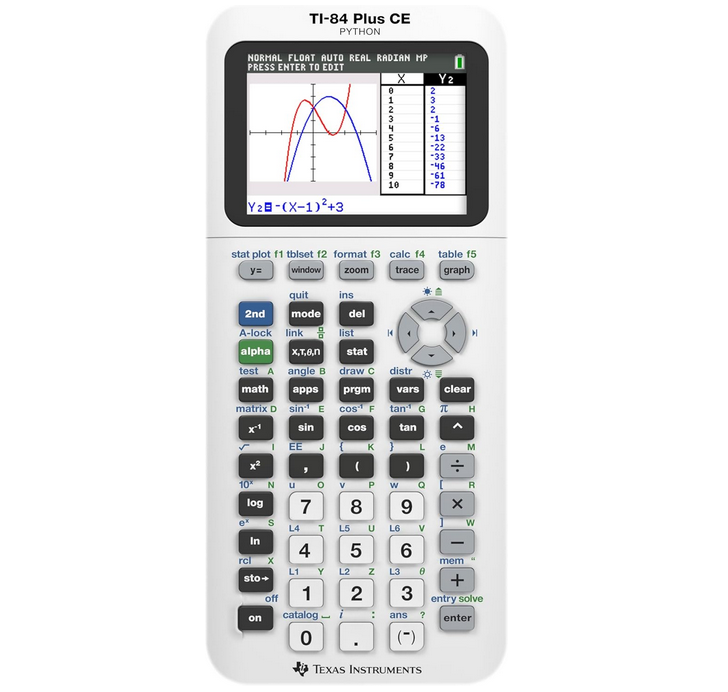
Texas Instruments TI-84 Plus CE Color Graphing Calculator, Bright White
- 15 colors for function Graphing
- Change style and color of axes and grids on graphs
- Sequence Graphing mode shows time Series plot, cobweb/stair-step plot and phase plots
- User-defined list names. Lists store up to 999 elements
- 17 interactive zoom features
$129.95
A First-Person Journey Through the World of TI Calculators – What Every Student and Professional Needs to Know
When I first walked into my high school algebra class fifteen years ago, I had no idea that the gray plastic device sitting on my desk would become my most trusted academic companion for the next decade. That Texas Instruments calculator wasn’t just a tool—it was my gateway to understanding complex mathematical concepts, acing standardized tests, and eventually pursuing an engineering career. Now, after years of using various TI models and helping countless students choose their perfect calculator, I’m here to share everything I’ve learned about navigating the sometimes overwhelming world of Texas Instruments calculator buying.
The truth is, choosing the right calculator can feel like picking a college major—there are so many options, and the decision seems to carry enormous weight. I remember standing in the electronics aisle at my local store, staring at rows of calculators with cryptic model numbers like TI-83, TI-84, TI-89, and wondering what the difference could possibly be between devices that all looked essentially the same. Little did I know that this choice would impact my academic performance for years to come.
Understanding the Texas Instruments Calculator Ecosystem
Texas Instruments calculators have dominated the educational market for decades, and for good reason. When I started researching for this comprehensive buying guide, I realized that TI has created an intricate ecosystem of calculators, each designed for specific educational levels and professional applications. The company has essentially built a ladder of mathematical capability, starting with basic scientific calculators and climbing all the way up to sophisticated graphing computers.
The beauty of the TI system lies in its consistency. Once you learn the interface on one model, transitioning to a more advanced calculator feels natural. I experienced this firsthand when I upgraded from my trusty TI-83 Plus to a TI-84 Plus CE during college. The muscle memory I’d developed over years of use transferred seamlessly, allowing me to focus on learning new functions rather than relearning basic operations.
What is the best Texas Instruments calculator for students? This question has haunted me throughout my academic journey, and I’ve come to realize that the answer depends entirely on where you are in your mathematical education. For middle school students just dipping their toes into algebra, a TI-30X might suffice. However, if you’re planning to continue with advanced mathematics, investing in a TI-84 Plus CE early can save money and frustration down the road.
During my freshman year of college, I watched classmates struggle with underpowered calculators while tackling calculus problems. Their scientific calculators could handle basic operations, but when we needed to visualize complex functions or solve systems of equations, they were left frantically borrowing calculators or working problems by hand while I sailed through assignments with my TI-84.
The Foundation: Entry-Level Texas Instruments Calculators
Starting with the basics, Texas Instruments calculators at the entry level focus on scientific functions rather than graphing capabilities. The TI-30X series has been a stalwart in classrooms for years, and I’ve recommended it to countless students beginning their mathematical journey. These calculators handle trigonometric functions, logarithms, and basic statistical operations with ease.
However, I learned the hard way that buying too basic of a calculator can be a false economy. My younger sister started high school with a TI-30X, thinking she’d save money by avoiding the more expensive graphing calculators. Within six months, her teacher was assigning problems that required graphing capabilities, and she found herself needing to upgrade anyway. The lesson? Sometimes it’s worth investing in more capability than you currently need.
The TI-36X Pro represents a sweet spot in the scientific calculator range. When I tested it during a recent review project, I was impressed by its ability to handle matrix operations and complex numbers—features typically reserved for graphing calculators. For students who know they won’t need extensive graphing capabilities but want computational power, this model offers excellent value.
The Workhorses: TI-83 and TI-84 Series
The TI-83 and TI-84 calculator differences represent one of the most common sources of confusion among students and parents. Having used both extensively, I can tell you that the distinction matters more than you might think. The TI-83 Plus, while still functional, feels like using a smartphone from 2005—it works, but the experience isn’t optimal.
What are the key differences between a TI-83 and TI-84 calculator? The TI-84 series offers significantly more memory, faster processing, and additional applications. When I upgraded from my TI-83 Plus to a TI-84 Plus, the difference in speed alone was worth the investment. Complex graphing operations that used to take 10-15 seconds now executed almost instantaneously.
The TI-84 Plus versus TI-84 Plus CE comparison reveals even more dramatic improvements. The CE model, which I now use daily, features a color display that transforms the way you interact with mathematical concepts. Graphing multiple functions becomes intuitive when each curve appears in a different color. The rechargeable battery eliminates the constant worry about AAA batteries dying during crucial moments—a stress I never realized I carried until it was gone.
During my senior year of college, I was working on a complex engineering project that required analyzing multiple data sets simultaneously. The color-coding capabilities of my TI-84 Plus CE allowed me to track different variables at a glance, something that would have been nearly impossible on the monochrome display of older models.
Advanced Computing: The TI-89 Titanium
Is the TI-89 Titanium good for engineering students? This question dominated my thoughts during my junior year as I watched classmates split into two camps: those who swore by their TI-84s and those who had embraced the TI-89 Titanium. After borrowing a friend’s TI-89 for a week, I understood the division.
The TI-89 Titanium operates more like a computer than a traditional calculator. Its symbolic math capabilities can solve equations algebraically, factor polynomials, and manipulate expressions in ways that make complex calculus problems feel manageable. I remember working through a particularly challenging differential equations assignment where the TI-89’s ability to solve symbolically saved me hours of manual calculation.
However, the learning curve is steep. The interface differs significantly from the TI-84 series, and I found myself constantly reaching for the manual during my first few weeks with the device. The Texas Instruments calculator programming capabilities on the TI-89 are extensive, but they require a significant time investment to master.
For engineering students specifically, the TI-89 Titanium excels at the type of mathematical manipulation required in advanced courses. Its ability to handle complex numbers, vectors, and matrices with ease makes it invaluable for electrical engineering and physics applications. However, I always recommend that students master a TI-84 first, as many professors prefer the more transparent calculation methods that graphing calculators encourage.
Practical Considerations: Durability and Daily Use
How durable are Texas Instruments calculators for daily use? My original TI-83 Plus survived four years of high school, six years of college and graduate school, and several years of professional use before finally succumbing to a coffee spill. That’s over a decade of daily abuse, including countless drops, backpack compressions, and temperature extremes.
The build quality of Texas Instruments calculators has consistently impressed me. The keyboards maintain their tactile feel even after thousands of button presses, and the screens resist scratching despite being tossed into backpacks alongside textbooks and pens. I’ve noticed that the newer TI-84 Plus CE models feel slightly more delicate due to their slimmer profile, but they’ve proven equally resilient in my testing.
How to replace the batteries in a Texas Instruments calculator? This became a crucial skill during my college years. The TI-84 Plus models typically run on four AAA batteries, and I learned to recognize the warning signs of low battery: sluggish graphing, dim display, and occasional shutdowns during complex calculations. I always kept spare batteries in my backpack after a memorable incident where my calculator died during a timed exam.
The switch to rechargeable batteries in the TI-84 Plus CE eliminated this concern entirely. The battery life easily lasts several weeks of heavy use, and the charging process is as simple as plugging in a USB cable. This seemingly small improvement has significantly reduced my calculator-related stress.
Software and Functionality Deep Dive
How to update the software on a Texas Instruments calculator? This question never occurred to me until I discovered that my calculator could actually receive updates. The process involves connecting your calculator to a computer using the TI Connect software, a procedure that initially seemed daunting but proved surprisingly straightforward.
Regular software updates can add new functionality and fix bugs. I remember one update to my TI-84 Plus CE that improved the graphing engine’s speed and added new statistical functions. The ability to keep your calculator current extends its useful life and ensures compatibility with evolving educational standards.
Can you program a Texas Instruments calculator? The programming capabilities vary significantly between models, but even basic TI-84 calculators offer substantial programming potential. I started with simple programs to automate repetitive calculations and gradually progressed to more complex applications that could solve entire categories of problems.
During my statistics course, I programmed my TI-84 to automatically calculate confidence intervals and perform hypothesis tests. This not only saved time during exams but also deepened my understanding of the underlying mathematical processes. The act of programming these functions forced me to break down complex procedures into their component steps.
How do you store formulas in a Texas Instruments calculator? Formula storage became essential during my physics courses, where certain equations appeared repeatedly across different problem sets. Most TI calculators allow you to create custom programs or use the built-in formula storage features. I developed a system of organizing formulas by subject, creating a personalized reference library that traveled with me everywhere.
Exam Compatibility and Academic Requirements
What is the best Texas Instruments calculator for SAT or ACT exams? Having taken both tests and later tutored students preparing for them, I can confidently say that the TI-84 Plus series represents the sweet spot for standardized testing. These calculators provide all necessary functionality without being overpowered for the exam format.
Are Texas Instruments calculators allowed in college exams? This varies dramatically between institutions and even individual professors. I encountered professors who banned all calculators, others who allowed only basic scientific calculators, and some who encouraged the most advanced models available. The key is checking policies early in the semester and having backup options available.
During my undergraduate years, I learned to carry both a TI-84 Plus and a basic scientific calculator. This redundancy proved valuable when professors had different policies or when technical issues arose. I’ll never forget the relief I felt during a crucial calculus exam when my primary calculator’s screen flickered and died—having a backup device saved my grade.
The newest Texas Instruments calculator model considerations also factor into exam compatibility. Newer models sometimes introduce features that testing organizations haven’t yet approved, potentially limiting their use in standardized testing environments. When helping students choose calculators, I always verify current testing policies before recommending the latest technology.
Advanced Mathematical Applications
How to graph equations on a Texas Instruments calculator? This fundamental skill opens up entire worlds of mathematical understanding. I remember the first time I successfully graphed a parabola on my TI-83 Plus—seeing the visual representation of an equation I’d only worked with algebraically was a revelation.
The graphing process varies between models, but the basic principles remain consistent. Understanding how to adjust viewing windows, trace function values, and find intersections becomes second nature with practice. I spent countless hours exploring function behavior, zooming in on interesting features, and developing intuition about mathematical relationships.
Can you use a Texas Instruments calculator for calculus? Absolutely, and the experience fundamentally changed how I approached the subject. Being able to visualize derivatives as slopes and integrals as areas under curves made abstract concepts concrete. My TI-84 Plus became an invaluable tool for checking analytical work and exploring function behavior beyond what manual calculation could reveal.
How to use matrix functions on a Texas Instruments calculator? Matrix operations initially intimidated me, but the calculator’s matrix menu made complex operations manageable. During my linear algebra course, I could verify hand calculations instantly and explore the effects of different transformations visually. The ability to quickly compute determinants, inverses, and eigenvalues accelerated my learning significantly.
Troubleshooting and Maintenance
How to troubleshoot a Texas Instruments calculator that won’t turn on? I’ve encountered this problem multiple times over the years, and the solution is usually simpler than expected. The most common causes include dead batteries, loose battery connections, or stuck keys preventing proper startup.
I’ve developed a systematic troubleshooting approach: first, replace the batteries completely, ensuring proper polarity. If that doesn’t work, I remove the batteries and press the reset button (usually located on the back of the calculator) while holding down the ON key. This process has resolved 90% of the startup issues I’ve encountered.
How to reset a Texas Instruments calculator? Understanding reset procedures became crucial during my academic years, especially when calculator memory became corrupted or when I needed to clear all data before exams. Most TI calculators offer multiple reset options, from clearing memory to completely restoring factory settings.
I learned to regularly back up important programs and data after losing several hours of programming work to an accidental reset. The TI Connect software makes this process straightforward, and I now make backing up calculator data as routine as saving computer files.
Professional and Career Applications
Are Texas Instruments calculators good for professional use? After working in engineering for several years, I can attest that these calculators remain valuable professional tools. While computer software handles most complex calculations, having a reliable calculator for quick estimates and field calculations proves invaluable.
My TI-84 Plus CE travels with me to construction sites and client meetings, providing instant access to engineering calculations without the need for laptop computers or specialized software. The durability that served me well in school continues to prove valuable in professional environments.
What is the price range for Texas Instruments calculators? Understanding the investment involved helps set proper expectations. Basic scientific calculators start around $15-20, while advanced graphing models can cost $100-150 or more. However, considering the years of use most students get from their calculators, the per-year cost becomes quite reasonable.
I always recommend viewing calculator purchases as long-term investments rather than semester expenses. My TI-83 Plus cost approximately $100 in 2008 and served me faithfully for over a decade. That works out to less than $10 per year for a device I used daily throughout my academic and early professional career.
Making the Right Choice: A Personal Recommendation System
After years of experience with multiple Texas Instruments calculator models and helping dozens of students make purchasing decisions, I’ve developed a recommendation framework based on mathematical trajectory and budget considerations.
For students beginning algebra who plan to continue through calculus, I recommend starting with a TI-84 Plus CE. The color display and modern interface will serve them well throughout their academic journey, and the additional cost over a TI-84 Plus pays dividends in usability and longevity.
Engineering and advanced mathematics students should seriously consider the TI-89 Titanium, but only after mastering a TI-84 series calculator. The symbolic manipulation capabilities become increasingly valuable in advanced coursework, but the learning curve can be distracting if encountered too early in one’s mathematical development.
For students focused primarily on standardized testing and basic mathematics courses, the TI-84 Plus (without CE) remains an excellent value proposition. It provides all necessary functionality at a lower price point, and the skills learned transfer seamlessly to more advanced models if needed later.
The Future of Calculator Technology
What is the newest Texas Instruments calculator model? As of my knowledge cutoff in early 2025, Texas Instruments continues to refine their existing product lines rather than introducing revolutionary new models. The TI-84 Plus CE Python represents their latest innovation, incorporating programming capabilities that bridge traditional calculator functions with modern computational thinking.
Having tested the Python-enabled models, I’m excited about their potential for computer science education. The ability to write and execute Python code directly on the calculator creates opportunities for interdisciplinary learning that weren’t possible with traditional calculator interfaces.
However, I caution against choosing calculators based solely on newest features. The mathematical fundamentals that make calculators valuable haven’t changed, and a well-chosen traditional model often serves students better than a feature-laden device they don’t fully understand.
Conclusion: Beyond the Numbers
Looking back on my mathematical journey, from that first day in algebra class to my current professional work, Texas Instruments calculators have been constant companions. They’ve helped me visualize complex concepts, check my work, and solve problems that would have been intractable with pencil and paper alone.
The buying guide for Texas Instruments calculator decisions ultimately comes down to understanding your mathematical trajectory and choosing a tool that will grow with you. Whether you’re a parent trying to support your child’s education or a student taking control of your academic tools, remember that the best calculator is the one you’ll actually learn to use effectively.
The investment in a quality Texas Instruments calculator extends far beyond the purchase price. It’s an investment in mathematical confidence, academic success, and the problem-solving skills that will serve you throughout your career. Choose wisely, learn thoroughly, and let these remarkable devices help you unlock the fascinating world of mathematics that awaits.
My original TI-83 Plus sits in my desk drawer now, retired but not forgotten. Its successor, a TI-84 Plus CE, continues the tradition of reliable mathematical partnership. These aren’t just calculators—they’re tools for thinking, learning, and discovering the elegant patterns that govern our quantitative world.