
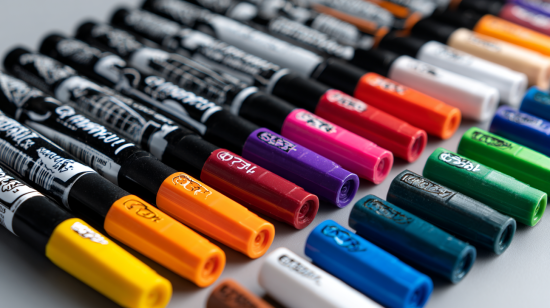
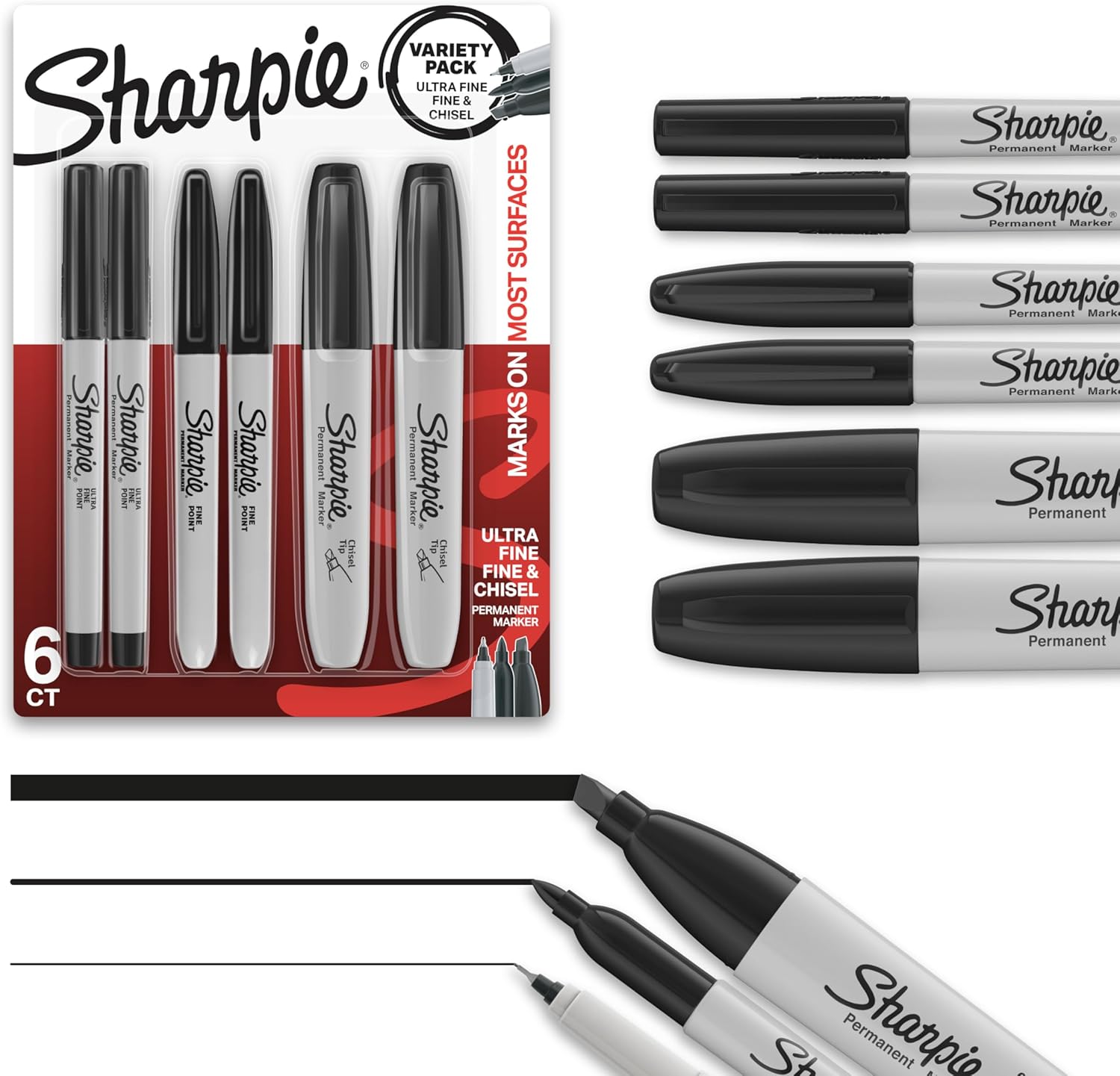
Sharpie Permanent Markers Variety Pack, Includes Chisel, Fine, and Ultra-Fine Tips, Marker Set, Writing, Coloring, Poster, Office, School Supplies, Black, 6 Count
- Sharpie Permanent Markers with vivid ink
- Marks on paper, plastic, metal, and most other surfaces
- Dries quickly and resists fading and water; AP certified
- Variety pack features markers with fine, ultra-fine, and chisel tips
- Includes 2 fine, 2 ultra-fine, and 2 chisel-tip black Sharpie permanent markers
$4.63
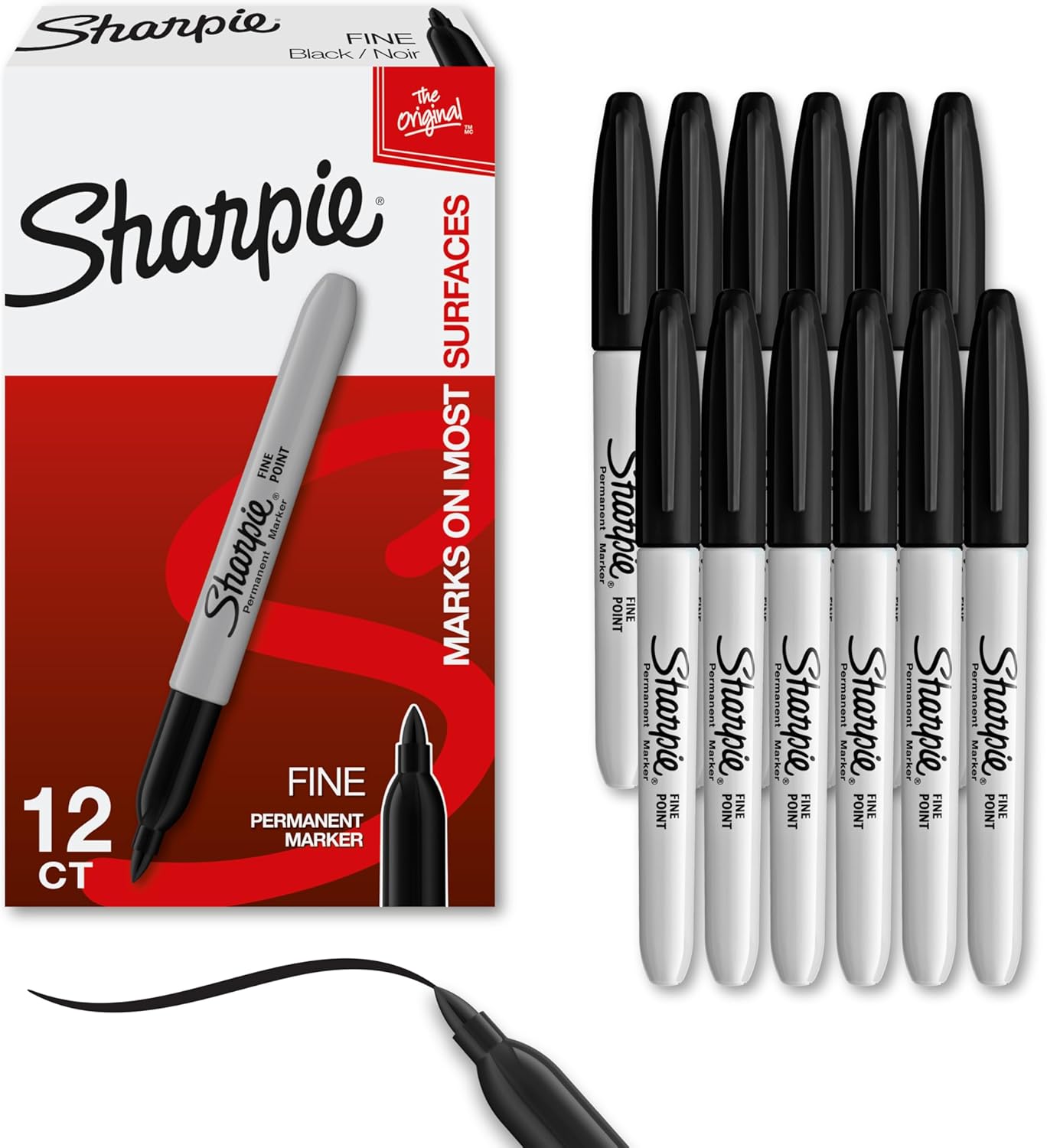
Sharpie Permanent Markers Set Quick Drying And Fade Resistant Fine Point Marker For Wood Plastic Paper Metal And More Drawing Coloring And Poster Marker Black 12 Count
- Fine-tipped, Detailed Marks: Versatile fine tip allows users to make eye-catching, impressive marks
- Permanent Ink: Makes a resilient mark on paper, plastic, and metal surfaces
- Quick-Drying: Quick-drying feature ensures writing resilience against water and prevents smudging
- Vibrant Impressions: Rich black color ensures vibrant marks to differentiate key points
- AP Certified: Ideal for various environments including schools and businesses
- High Quantity: Pack includes 12 black Sharpie permanent markers
- Fade Resistant: Ensures long-lasting marks that resist fading over time
$8.94
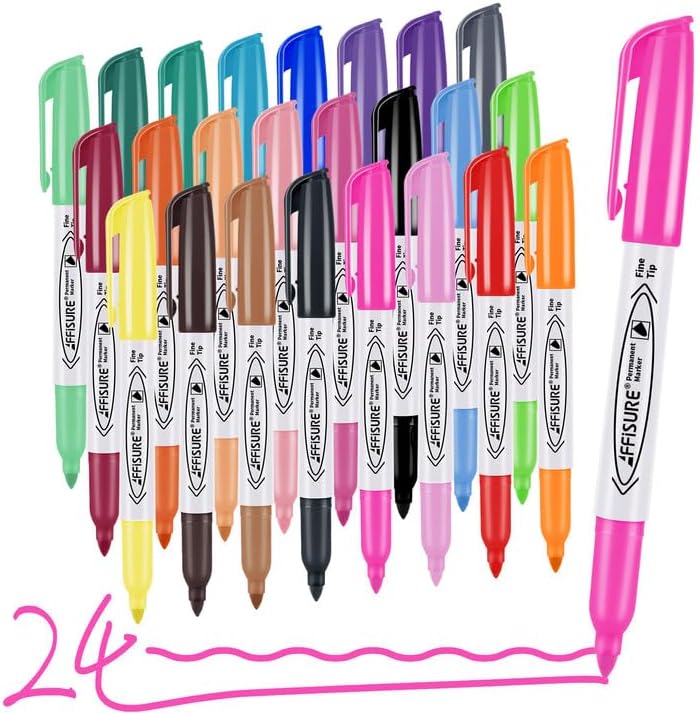
Permanent Markers Assorted Colors Set, 24 Colored Markers 24 Pack, Fine Point,Works on Wood, Plastic, Metal, and More, for Adults, Artist, Taecher, Kids
- COLOR PERMANENT MARKERS: 24 Count Bulk Permanent Marker, including 24 colors permanent markers with fine point, Colored markers are the best gift for little ones and the first choice for home, office or school markers.
- QUICKLY DRYING PERMANENT MARKER: The colored permanent markers’ ink has professional formula, the color permanent markers can dry quickly in one second and they are long-lasting, very suitable for coloring、painting、writing、drawing、marking out
- MULTI-COLOR PERMANENT MARKER USE RANGE: Color permanent marker allows creativity beyond paper and helps children imagine enlightenment, suitable for fine point permanent markers of plastic, glass, metal, wood, stone and other materials
- WATERPROOF AND WEAR-RESISTANT PERMANENT MARKER: After the permanent mark block is colored and dried, it can form a protective film and has water resistance.The surface is made of plastic.
- EXQUISITE GIFT: Color permanent markeare the best Christmas gift for children, which can help them unleash their creativity and imagination. Children and parents can also paint together, making it an ideal choice
$7.99
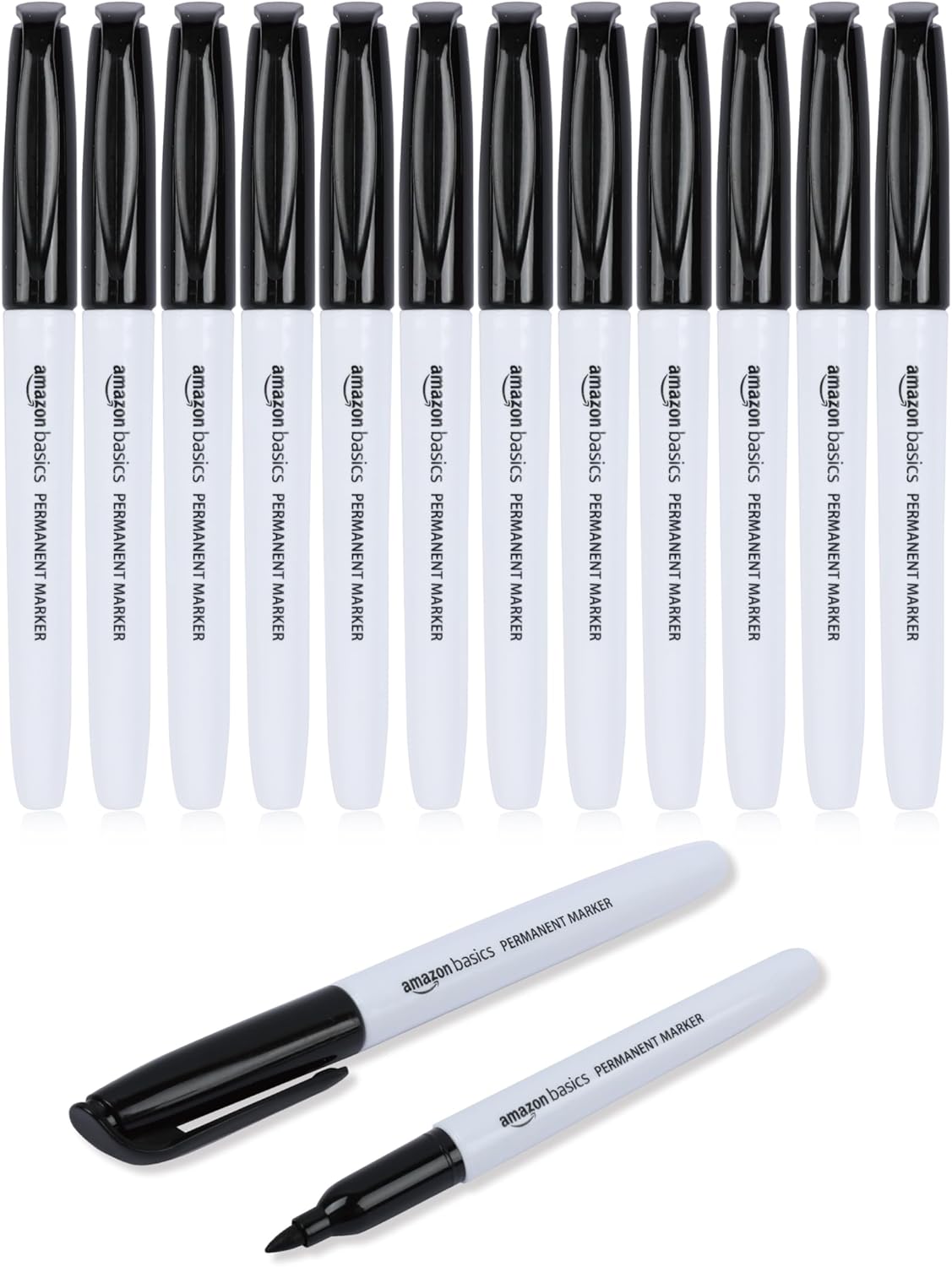
Amazon Basics Fine Tip Point Permanent Markers for Office, School, and Home Use, Black, 12 Pack
- BOLD MARKS & CLEAN LINES: The fine point permanent marker produces clear lines making it great for writing, doodling, and drawing with precision
- VERSATILE USAGE: The black permanent markers are well-suited for photos, plastic, wood, and metal
- LONG-LASTING VIVID INK: With quick-drying, waterproof ink that stays permanent, these black markers keep your work vibrant and detailed for a long time
- WARNINGS: Keep out of reach of children. Avoid contact with eyes, Rinse eyes immediately if product comes into contact with them. The product should be labelled according to CLP regulation and SDs hazard warnings
$6.83
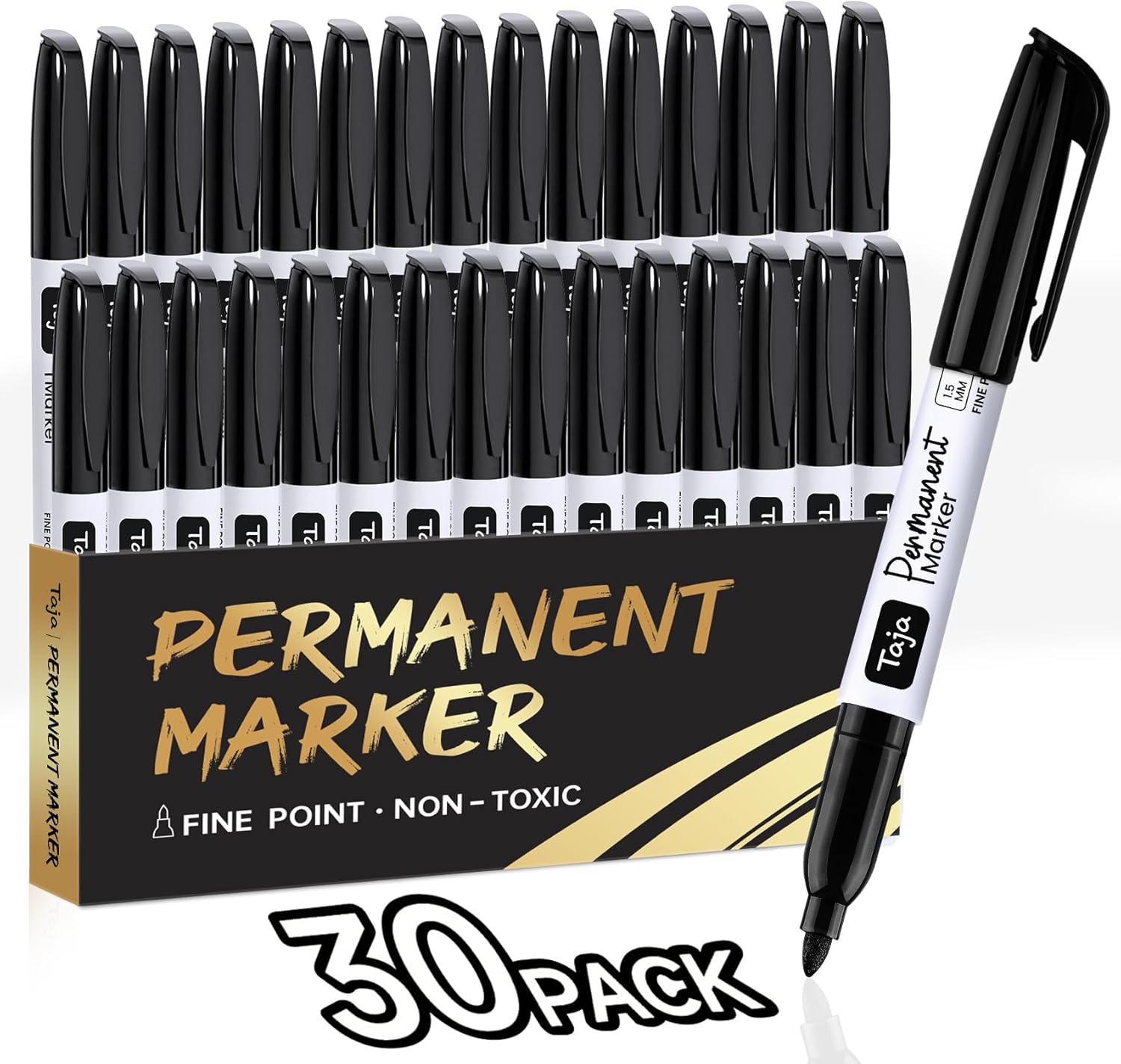
Permanent Markers Fine Tip, 30 Pack Black Quick-Drying and Fade-Resistant Permanent Markers Bulk Set for Writing and Drawing on Wood, Plastic, Metal, Glass, Stone, Ideal for Office School Supplies
- Big Value Pack: Includes 30 black permanent markers in one practical, easy-to-access pack. Whether you’re stocking up for a classroom, office, art studio, or shipping department, this bulk set ensures you’ll always have reliable markers on hand—no last-minute shortages, no interrupted workflow.
- Bold and Controlled Marking: Equipped with a 1.5mm fine tip, each marker creates bold, easy-to-read lines with excellent control. Perfect for labeling, outlining, list-making, and creative projects on surfaces like paper, cardboard, wood, plastic, metal, and more—indoors or out.
- Quick-Dry, No Smudge:The fast-drying ink formula helps prevent smudging, smearing, and ink transfer—even when writing quickly or handling items immediately after marking. A dependable choice for both left-handed users and busy environments where speed and clarity matter.
- Waterproof & Fade-Resistant: Permanent ink is built to last—resistant to water, fading, and daily wear. Whether you’re marking storage boxes, tools, folders, or shipping labels, your writing stays clear and intact through handling, time, and exposure.
- Safe & Reliable Design: Made with non-toxic, low-odor ink that meets safety standards for school and office use. Safe enough for classrooms and shared workspaces, yet professional enough for warehouses, labs, and creative studios. Durable, comfortable, and built for extended daily use.
$7.99
Everything You Need to Know Before Buying Your Next Set of Permanent Markers
I’ll never forget the moment I discovered the true power of a quality permanent marker. It was during a frantic morning when I needed to label my daughter’s lunch containers before school, and my regular pen just wouldn’t stick to the plastic surface. That’s when I grabbed my trusty Sharpie, and suddenly everything clicked. The bold, lasting mark transformed not just that simple task, but my entire approach to organization, crafting, and creative projects.
If you’re reading this, chances are you’re facing a similar moment of realization about permanent markers. Whether you’re a teacher preparing classroom materials, an artist exploring new mediums, a parent organizing household items, or a professional needing reliable marking tools, choosing the right permanent marker can make all the difference in your projects’ success.
After years of testing countless brands, tips, and techniques, I’ve learned that not all permanent markers are created equal. Some claim to be waterproof but fade after the first rain, others boast fine tips that fray within weeks, and many promise vibrant colors that turn out disappointingly dull. Through trial and error (and yes, plenty of mistakes), I’ve discovered what truly separates exceptional permanent markers from the mediocre ones cluttering store shelves.
Understanding the Anatomy of a Quality Permanent Marker
Before diving into specific recommendations, let’s talk about what makes a permanent marker actually permanent. The secret lies in the ink formulation, which typically contains powerful solvents that allow the pigments to penetrate deeply into surfaces rather than merely sitting on top. This chemical composition is what gives permanent markers their staying power, but it’s also what determines their safety profile and environmental impact.
The best brands for permanent markers have spent decades perfecting this balance. Sharpie, arguably the most recognizable name in the market, has built its reputation on consistent quality and reliability. Their classic black markers have become the gold standard for most applications. However, other brands like Prismacolor, Staedtler, and Sakura have carved out their own niches with specialized features.
Prismacolor markers, for instance, excel in artistic applications with their smooth ink flow and vibrant color saturation. I’ve used them extensively for illustration work, and their ability to blend seamlessly makes them invaluable for creative projects. Staedtler offers excellent precision with their fine-tip options, making them my go-to choice for detailed labeling work. Sakura’s Pigma Micron series, while technically not traditional permanent markers, provides archival quality that’s perfect for important documents or artwork meant to last generations.
The Longevity Question: How Long Will Your Investment Last?
One of the most common questions I encounter is: “How long does the ink in a permanent marker last?” The answer isn’t straightforward because it depends on several factors including storage conditions, frequency of use, and the specific brand you choose.
In my experience, a high-quality permanent marker can maintain its potency for two to three years when stored properly. However, I’ve discovered that proper storage is crucial. Markers should always be stored horizontally or with the tip pointing downward to prevent the ink from settling away from the tip. Temperature fluctuations can also affect longevity, so avoid leaving markers in hot cars or freezing garages.
I learned this lesson the hard way when I left a expensive set of art markers in my studio during a particularly cold winter. Come spring, half of them had dried out completely. Now I keep my markers in a climate-controlled environment, and the difference in their lifespan has been remarkable.
Safety First: Permanent Markers and Children
As a parent, the question “Are permanent markers safe for children to use?” hits close to home. The honest answer is that while permanent markers aren’t inherently dangerous, they do require adult supervision and proper safety measures.
Traditional permanent markers contain solvents that can be harmful if inhaled in large quantities or if the ink comes into contact with skin repeatedly. For this reason, I always ensure good ventilation when my children use permanent markers, and I’ve taught them never to put the markers near their faces or mouths.
For younger children, I recommend looking for non-toxic permanent markers specifically designed for kids. Crayola makes an excellent washable version that provides the bold coverage of permanent markers while being much safer for small hands. These markers still require supervision, but they offer peace of mind for parents who want to encourage creativity without compromising safety.
The key is education and supervision. I’ve found that children as young as six can safely use permanent markers for appropriate projects when they understand the rules: keep the caps on when not in use, never put markers in their mouths, and always wash hands afterward.
The Removal Dilemma: When Permanent Isn’t Forever
Despite the name, permanent marker ink can be removed from surfaces with the right approach and tools. This knowledge has saved me countless times when accidents happen (and they always do).
The most effective removal method I’ve discovered involves rubbing alcohol or acetone-based nail polish remover. For hard surfaces like whiteboards, glass, or metal, I apply the alcohol to a cloth and gently rub the marked area. The solvent breaks down the permanent ink, making it surprisingly easy to wipe away.
For fabric removal, the process is more involved. How to remove permanent marker from clothes has become one of my most-asked questions from friends and family. My go-to method involves placing a clean cloth underneath the stained fabric, then dabbing (not rubbing) the stain with rubbing alcohol from the top. The ink will transfer to the cloth underneath. It’s crucial to work from the outside of the stain inward to prevent spreading.
I’ve also had success with hand sanitizer for emergency removals. The alcohol content in most hand sanitizers is sufficient to break down fresh permanent marker stains, making it a convenient option when you’re away from home.
Surface Compatibility: Where Permanent Markers Excel
Understanding what surfaces work best with permanent markers has transformed how I approach different projects. Through extensive testing, I’ve learned that porous surfaces like paper, cardboard, and uncoated wood provide the best adhesion and longevity for permanent marker ink.
Non-porous surfaces present more challenges but aren’t impossible. Can permanent markers be used on glass? Absolutely, and the results can be stunning. I’ve used permanent markers to create decorative designs on glass vases and picture frames with excellent results. The key is ensuring the glass is completely clean and dry before application.
Metal surfaces also work well with permanent markers, though preparation is crucial. Can permanent markers be used on metal surfaces? Yes, but I always clean the metal with rubbing alcohol first to remove any oils or residues that might prevent proper adhesion.
Plastic surfaces fall somewhere in the middle. While permanent markers will adhere to most plastics, the longevity varies depending on the type of plastic and environmental exposure. I’ve had mixed results with outdoor plastic applications, where UV exposure and weather can cause fading more quickly than expected.
Waterproof Properties: Truth in Advertising
The question “Are permanent markers waterproof?” deserves a nuanced answer. Most quality permanent markers are indeed water-resistant once fully dry, but true waterproof performance varies by brand and application surface.
In my testing, I’ve found that Sharpie markers perform exceptionally well in wet conditions when used on appropriate surfaces. I’ve labeled outdoor plant stakes and storage containers that have withstood months of rain and irrigation without noticeable fading. However, the same markers on paper will show some bleeding when exposed to significant moisture.
For truly waterproof applications, I recommend looking for markers specifically labeled as weatherproof or marine-grade. These specialized products cost more but provide superior performance in challenging conditions.
Tip Types: Fine vs. Chisel and Everything Between
The difference between fine-tip and chisel-tip permanent markers goes far beyond just line width. Each tip type serves specific purposes and offers unique advantages.
Fine-tip markers (typically 0.5mm to 1mm) excel in detailed work. I use them for precise labeling, technical drawings, and any application where accuracy is paramount. The thin line allows for more text in smaller spaces and creates cleaner, more professional-looking results.
Chisel tips offer versatility that fine tips can’t match. With a chisel tip, you can create both broad strokes and fine lines depending on the angle and pressure applied. I find these invaluable for highlighting, broad coverage areas, and creative lettering projects.
Beyond these standard options, specialty tips like brush tips and ultra-fine points serve specific niches. Brush tips, found in markers like Tombow Dual Brush Pens, provide watercolor-like effects while maintaining permanent ink properties. Ultra-fine tips (0.3mm and smaller) offer precision that rivals technical pens.
Reviving Dried-Out Markers: Second Chances
Learning how to revive a dried-out permanent marker has saved me significant money over the years. While not every marker can be rescued, many can be brought back to life with simple techniques.
The most effective method I’ve found involves adding a few drops of rubbing alcohol to the marker’s ink reservoir. For most markers, you can carefully remove the back plug (using pliers if necessary) and add 2-3 drops of 91% isopropyl alcohol. Replace the plug and let the marker sit tip-down for several hours.
For markers with removable tips, I sometimes soak the tip in alcohol for 10-15 minutes before reassembling. This method works particularly well for fine-tip markers that have become clogged rather than truly dried out.
Prevention remains the best strategy. How to prevent permanent markers from drying out involves proper storage techniques: always replace caps immediately after use, store markers horizontally or tip-down, and avoid extreme temperatures.
Artistic Applications: Beyond Basic Labeling
The uses of permanent markers in art projects extend far beyond what most people imagine. As someone who’s explored various artistic mediums, I’ve discovered that permanent markers offer unique advantages for creative work.
Alcohol-based permanent markers excel in mixed media applications. They work beautifully over dried acrylic paint, creating bold accents and fine details that would be difficult to achieve with brushes. I’ve used them to add precise linework to paintings and to create intricate patterns on various surfaces.
For textile art, permanent markers designed specifically for fabric open up endless possibilities. How to use permanent markers on fabric without bleeding requires understanding fabric preparation and application techniques. I always pre-wash fabric to remove sizing and manufacturing residues, then place cardboard inside garments to prevent bleed-through.
The layering capabilities of permanent markers make them excellent for creating depth and texture in artwork. Unlike traditional markers, permanent markers can be layered without muddying, allowing for complex color interactions and gradient effects.
Environmental Considerations: Eco-Friendly Options
The environmental impact of permanent markers has become increasingly important to conscious consumers. Are there eco-friendly permanent markers available? The answer is yes, though options remain somewhat limited.
Several companies now produce permanent markers using recycled plastics for the barrel and cap construction. Some brands have also reformulated their inks to reduce volatile organic compounds (VOCs) while maintaining permanent adhesion properties.
Refillable permanent markers represent another environmentally conscious option. While less common than disposable versions, refillable markers significantly reduce waste over their lifetime. Staedtler and Pilot both offer refillable permanent marker systems, though the initial investment is higher than disposable options.
When shopping for eco-friendly options, look for certifications from recognized environmental organizations and read ingredient lists carefully. Some manufacturers make vague environmental claims without substantive backing.
Health and Safety: Understanding Toxicity
The question “Is permanent marker ink toxic?” requires careful consideration of exposure routes and quantities. While permanent markers are generally safe for normal use, understanding their chemical composition helps ensure safe handling.
Most permanent marker inks contain solvents like xylene, toluene, or ethyl alcohol. These compounds can cause irritation with prolonged skin contact or if inhaled in large quantities. However, normal use with proper ventilation poses minimal risk to healthy adults.
I always recommend working in well-ventilated areas and taking breaks during extended use sessions. If you experience headaches, dizziness, or respiratory irritation while using permanent markers, take a break and move to fresh air.
For people with chemical sensitivities or respiratory conditions, water-based permanent markers offer a safer alternative. While they may not perform identically to solvent-based versions, they provide similar permanence with reduced fumes.
Color Options and Sets: Building Your Collection
What colors are typically available in permanent marker sets? Most basic sets include black, blue, red, and green, but premium collections can include dozens of colors spanning the entire spectrum.
When building a permanent marker collection, I recommend starting with a basic set of primary colors plus black. These four colors handle the majority of labeling and basic craft needs. As your needs expand, you can add specialty colors or upgrade to larger sets.
For artistic applications, consider sets that include both warm and cool versions of primary colors. Having both warm and cool reds, blues, and yellows dramatically expands your color mixing possibilities.
Some manufacturers offer colors specifically formulated for certain applications. Metallic permanent markers, for instance, work exceptionally well on dark surfaces where traditional colors would be difficult to see.
Durability and Fading: Long-Term Performance
Do permanent markers fade over time? Unfortunately, yes, though the rate of fading depends on multiple factors including ink quality, surface type, and environmental exposure.
UV light represents the greatest threat to permanent marker longevity. I’ve observed significant fading in markers exposed to direct sunlight over several months. For outdoor applications or items displayed in sunny windows, look for UV-resistant formulations.
Indoor applications typically show much better longevity. Labels I created five years ago using quality permanent markers still appear vibrant today, with minimal fading or degradation.
Heat also accelerates fading. I learned this lesson when permanent marker labels on items stored in my garage showed noticeable fading after just one summer. Now I use specialized high-temperature markers for applications that will experience heat exposure.
Price Considerations: Value vs. Cost
What is the price range for permanent marker sets? Prices vary dramatically based on quality, brand, and set size. Basic sets of four markers can cost as little as $3, while professional artist sets can exceed $100.
In my experience, the cheapest options often prove false economy. Low-cost markers frequently dry out quickly, provide inconsistent coverage, and may not truly be permanent. Investing in mid-range options typically provides better value through improved longevity and performance.
For occasional use, basic name-brand markers like Sharpie provide excellent value. For frequent use or professional applications, premium brands like Prismacolor or Staedtler justify their higher cost through superior performance and longevity.
Storage and Maintenance: Maximizing Your Investment
Proper storage extends marker life significantly. I store my permanent markers in a dedicated organizer that keeps them horizontal and easily accessible. Vertical storage with tips pointing down also works well, but avoid storing tips upward as this can cause ink to settle away from the tip.
Temperature control matters more than most people realize. Extreme temperatures can cause ink to thicken or thin, affecting flow and coverage. I keep my markers in a temperature-controlled environment and have noticed significantly better performance compared to markers stored in unheated spaces.
Regular use actually helps maintain marker performance. Markers used frequently are less likely to clog or dry out compared to those sitting unused for months. If you have markers you don’t use often, make a point to test them periodically to ensure they remain functional.
Making Your Decision: The Perfect Permanent Marker for Your Needs
After years of testing and using permanent markers in countless applications, I’ve learned that the “best” marker depends entirely on your specific needs. For general household use, I recommend starting with a basic Sharpie set supplemented by a few fine-tip options for detailed work.
Artists should consider investing in alcohol-based markers like Prismacolor or Copic for their superior blending properties and color selection. Teachers and office workers often benefit from chisel-tip markers that provide versatility for both writing and highlighting.
For outdoor applications, look for markers specifically labeled as weatherproof or UV-resistant. While these cost more initially, they provide better long-term value for challenging conditions.
Safety-conscious users should prioritize non-toxic formulations and ensure adequate ventilation regardless of the markers chosen. Remember that proper technique and environmental awareness matter as much as marker selection for safe use.
The journey to finding your perfect permanent marker might involve some trial and error, but understanding these key factors will help you make informed decisions that match your specific needs and budget. Whether you’re labeling storage containers, creating artwork, or tackling professional projects, the right permanent marker will serve you reliably for years to come.
Remember that permanent markers are tools, and like any tool, their effectiveness depends on proper selection, use, and maintenance. Take time to understand your specific requirements, invest in quality products that match your needs, and maintain them properly for optimal performance. With the right approach, permanent markers will become indispensable tools in your creative and organizational toolkit.